Areas where I need to/have improved:
1. Making the speech entertaining - While running for a state office, I had to make a public speech to accompany my campaign. One of the biggest mistakes I made was that I focused solely on substance and what I wanted to change in the organization. I put minimal work into making my speech entertaining, which was really important given my audience: middle and high school kids who lacked long attention spans.
One of my competitors made a speech with a reference to a popular movie. This immediately got people's attention and made the speech engaging and entertaining. In comparison, my speech was more content-based, but less interesting. I learned from this mistake and came back the following year to make a speech that had a better balance of content and entertainment. At the time, Frozen was a very popular movie, so I made an analogy using Frozen that made people interested while also explaining my content effectively. I think I also had an effective grabber in my RCL speech that made it more interesting.
2. Standing behind the podium - I made this mistake both years that I ran for state office. While the podium was tempting because I could have notes on it, it really inhibited my physical connection to the audience. I learned from this mistake, and in my RCL speech, I spoke from the side of the podium, where I could still access the computer, but was able to make a connection with the audience.
3. Body language/gestures - When practicing for my RCL speech in the Speaking Center, I made too many hand gestures, so I decided that I would hold my notes in both hands. While this strategy was effective for reducing hand movement, it made me appear stiff. I definitely need to work on this going forward. I would also like to incorporate physical body movement in the future. I just wasn't sure how to time it for my RCL speech.
4. Eye contact - I did make eye contact during my RCL speech, but it was too fleeting. I was trying to balance between making people feel uncomfortable and not making any eye contact. I need to work on knowing exactly how long I should "talk" to a particular individual in the audience.
Thursday, October 29, 2015

Thursday, October 22, 2015
Here comes the helicopter...parent
Thesis: In the past 40 years (between the time when our parents were kids and today), parenting has evolved from a largely hands off approach to a well-meaning, but intrusive intervention in young adults' lives that may harm students more than it helps them.
I will start by defining helicopter parenting in my first paragraph and then explain how I will develop my essay. First, I plan to provide evidence proving that the shift occurred. I hope to find evidence that specifically addresses, for example, how much time parents spent helping their children in the 1960s compared to now. I have already found some statistics (like the one shown below) that demonstrate how parents have specifically intervened in their children's lives.

Second, I will explain why the shift occurred. Already some plausible explanations are that people have fewer children today, which results in them investing more time into each one. Also, parents seem to feel more connected to their students' success and more worried about their job opportunities post-graduation. Additionally, parents may be feeling peer pressure from parents who are also over-involved in their children's lives. All of these factors and more contribute to this shift.
Third, I will talk about the significance of this shift. Many studies have found that students with helicopter parents are more afraid of failure, have more anxiety, have less self-esteem, and underdeveloped life skills. All of these issues have hindered rather than helped students be successful.
Fourth, I will introduce the counterargument and explain how parental attention can help students succeed in many cases. I think this is important because parents should not neglect their children, but rather, try to strike a balance between helicopter parenting and abandonment.
Then I will conclude reflecting on how we can change our behaviors going forward.
Sources:
http://www.parents.com/parenting/better-parenting/what-is-helicopter-parenting/
http://time.com/3904527/helicopter-parent-study-controlling-students-kids-children/
https://www.psychologytoday.com/blog/freedom-learn/201509/declining-student-resilience-serious-problem-colleges#_=_
https://www.law.uh.edu/ihelg/monograph/11-12.pdf
http://hereandnow.wbur.org/2015/08/18/how-to-raise-an-adult
I will start by defining helicopter parenting in my first paragraph and then explain how I will develop my essay. First, I plan to provide evidence proving that the shift occurred. I hope to find evidence that specifically addresses, for example, how much time parents spent helping their children in the 1960s compared to now. I have already found some statistics (like the one shown below) that demonstrate how parents have specifically intervened in their children's lives.

Second, I will explain why the shift occurred. Already some plausible explanations are that people have fewer children today, which results in them investing more time into each one. Also, parents seem to feel more connected to their students' success and more worried about their job opportunities post-graduation. Additionally, parents may be feeling peer pressure from parents who are also over-involved in their children's lives. All of these factors and more contribute to this shift.
Third, I will talk about the significance of this shift. Many studies have found that students with helicopter parents are more afraid of failure, have more anxiety, have less self-esteem, and underdeveloped life skills. All of these issues have hindered rather than helped students be successful.
Fourth, I will introduce the counterargument and explain how parental attention can help students succeed in many cases. I think this is important because parents should not neglect their children, but rather, try to strike a balance between helicopter parenting and abandonment.
Then I will conclude reflecting on how we can change our behaviors going forward.
Sources:
http://www.parents.com/parenting/better-parenting/what-is-helicopter-parenting/
http://time.com/3904527/helicopter-parent-study-controlling-students-kids-children/
https://www.psychologytoday.com/blog/freedom-learn/201509/declining-student-resilience-serious-problem-colleges#_=_
https://www.law.uh.edu/ihelg/monograph/11-12.pdf
http://hereandnow.wbur.org/2015/08/18/how-to-raise-an-adult
Thursday, October 15, 2015
Paradigm Shifts
Examples of paradigm shifts:
1. The evolution of the helicopter parent
 We've all heard about the rise of the helicopter parent who is overprotective, over-involved, and over-connected to their children's successes and failures in school and life. But forty to fifty years ago, when our parents were growing up, parents and children alike looked at parenting in an entirely different way. Your parents may have told you, as mine did, that they grew up bike riding to school uphill both ways for 15 miles with a broken leg and a broken arm in the snow. While, this is clearly an over exaggeration, there is some truth to the idea that children today are more sheltered than they were before. Check out the graphic below to see how parents have become more involved in their children's lives.
 I think there are many factors that have caused this shift. Definitely one of them is economic. After the economic crash in 2008, it became especially hard for people just out of college to find jobs. This, along with the introduction of the common application (which made it easier for students to apply to multiple colleges), increased the college craze and the obsession to get into a good school. Parents still believe that getting an Ivy League acceptance can guarantee their children a good life. Therefore many of them have taken it upon themselves to help get their children there. Another possible cause of the shift is that more parents are working full time today than were in the past. This may make them worry about neglecting their children, so they will often overcompensate by getting over-involved in some aspects of their children's lives. It's also important to remember that we often hold parents accountable when their child exhibits good or bad behavior. Parents may be motivated to help their children, so that they gain societal approval. As their kid succeeds, they succeed.
2. The move from institutionalizing mentally challenged people to trying to develop different programs to help them
Before the mid-1900s, if you were mentally ill, you were usually institutionalized for life. This was not meant to be a punishment; at the time, people genuinely believed that this was the best way to help these struggling individuals. Unfortunately, while they were able to get care, many of the institutions were poorly funded, so many patients lived in poor conditions.
Over time, we started to view mental health differently as more research was done and some antipsychotic drugs entered the market. This led to the new belief that these individuals would benefit more from living in society than in dreary hospitals where they had little human interaction. This recognition that these people needed to socialize and to be part of a community to be happy resulted in a large deinstitutionalization movement that ultimately improved mental health care.
1. The evolution of the helicopter parent
 We've all heard about the rise of the helicopter parent who is overprotective, over-involved, and over-connected to their children's successes and failures in school and life. But forty to fifty years ago, when our parents were growing up, parents and children alike looked at parenting in an entirely different way. Your parents may have told you, as mine did, that they grew up bike riding to school uphill both ways for 15 miles with a broken leg and a broken arm in the snow. While, this is clearly an over exaggeration, there is some truth to the idea that children today are more sheltered than they were before. Check out the graphic below to see how parents have become more involved in their children's lives.
2. The move from institutionalizing mentally challenged people to trying to develop different programs to help them
Before the mid-1900s, if you were mentally ill, you were usually institutionalized for life. This was not meant to be a punishment; at the time, people genuinely believed that this was the best way to help these struggling individuals. Unfortunately, while they were able to get care, many of the institutions were poorly funded, so many patients lived in poor conditions.
 |
| Courtesy of PBS |
Over time, we started to view mental health differently as more research was done and some antipsychotic drugs entered the market. This led to the new belief that these individuals would benefit more from living in society than in dreary hospitals where they had little human interaction. This recognition that these people needed to socialize and to be part of a community to be happy resulted in a large deinstitutionalization movement that ultimately improved mental health care.
Monday, September 14, 2015
Kairos's Influence on History
Today in class when we started talking about kairos, the so-called "window of opportunity" when it is the best time and place to introduce an argument, I though immediately of the story of Claudette Colvin. While many of you may not have heard of Ms. Colvin, you might have if her story had ended differently.
On March 2, 1955 Claudette was seated in the back of a segregated bus on her way home from school in Montgomery, Alabama. That day the bus was particularly crowded and more people were getting on with each stop. When the bus had run out of seats for an incoming white woman the bus driver ordered Claudette to move. She refused, saying, "This is my constitutional right...you have no right to do this." The bus driver threatened to call a policeman, but Claudette still would not relent. Eventually, she was forcibly removed from the bus and arrested.
 This story might sound familiar because Rosa Parks, Secretary of the NAACP, would go on to do the same thing in the same city nine months later. So why is it Parks - not Colvin - who we learn about in school, read about in books, and honor during Black History month? The short answer is kairos. At the time that Colvin was arrested, she was an unmarried teen who was pregnant with her first child. The NAACP decided she was too much of wildcard to be an emblem of their cause. They later settled on Rosa Parks as an ideal candidate because she was a more virtuous and humble figure.
If the timing had been different and Colvin had already had her child or the NAACP had been less sensitive to social norms and had decided to back Colvin in her case, the Civil Rights Movement might have had a very different flavor. Instead of having an older figure as its symbol - someone who was tired of giving in - the movement might have been characterized by young, fiery Claudette Colvin who was determined to stand up for her rights no matter the risk involved.
I find this so interesting because kairos can literally change the story of history. Many times a precursor to some of our most important discoveries was ignored because it was the wrong timing. But if we look back, many of these earlier events have shaped our actions today. In an argument, if we didn't say something at the right time, we can hold on to our comeback. We may even be better prepared to use it in the future. Kairos enables us to take advantage of a situation and manipulate it to get the result we want. The NAACP used Rosa Park's kairotic moment to trigger a movement that helped liberate a whole people. If all of us can learn to use kairos to our advantage, we can be better communicators and civic leaders.
On March 2, 1955 Claudette was seated in the back of a segregated bus on her way home from school in Montgomery, Alabama. That day the bus was particularly crowded and more people were getting on with each stop. When the bus had run out of seats for an incoming white woman the bus driver ordered Claudette to move. She refused, saying, "This is my constitutional right...you have no right to do this." The bus driver threatened to call a policeman, but Claudette still would not relent. Eventually, she was forcibly removed from the bus and arrested.

If the timing had been different and Colvin had already had her child or the NAACP had been less sensitive to social norms and had decided to back Colvin in her case, the Civil Rights Movement might have had a very different flavor. Instead of having an older figure as its symbol - someone who was tired of giving in - the movement might have been characterized by young, fiery Claudette Colvin who was determined to stand up for her rights no matter the risk involved.
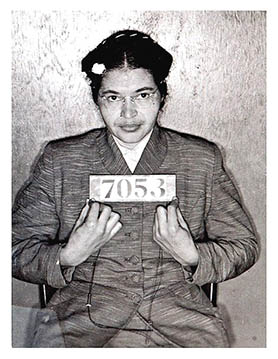 |
| Rosa Parks arrested in 1955, 9 months after Claudette Colvin |
I find this so interesting because kairos can literally change the story of history. Many times a precursor to some of our most important discoveries was ignored because it was the wrong timing. But if we look back, many of these earlier events have shaped our actions today. In an argument, if we didn't say something at the right time, we can hold on to our comeback. We may even be better prepared to use it in the future. Kairos enables us to take advantage of a situation and manipulate it to get the result we want. The NAACP used Rosa Park's kairotic moment to trigger a movement that helped liberate a whole people. If all of us can learn to use kairos to our advantage, we can be better communicators and civic leaders.
Thursday, September 3, 2015
My first blog post...about another blog?
Passion Blog Ideas:
My first idea is to respond every week to an editorial written by one of the columnists for The New York Times. The blog would include analyzing how and why they wrote the post (e.g. what kind of rhetorical techniques did they use? Ethos, pathos, or logos? Did they use imagery or startling facts?) as well as my personal reaction to what they are saying. I would probably pick David Brooks (check him out here) who I have followed in the past. I like interacting with his work because he is conservative, but he often plays the middle ground. Since I consider myself to be slightly more liberal, I like responding and critiquing his arguments. I think this will also be an exciting topic because the 2016 presidential election is fast approaching and there is already a lot of information out about the different competitors from both parties.
My second idea is to follow The Late Show with Stephen Colbert and to analyze what rhetorical strategies he uses to convince his audience of his arguments. I would also reflect on the content including his ideas and his criticisms of the right wing. I am super excited to see this show after seeing Mr. Colbert's performance on The Colbert Report. It will be interesting to see him acting as himself.
 My third idea is to write about hidden gem movies and TV shows from the 1960s and 1970s like "Get Smart" (the TV show, not the remake movie), "Stripes," "Airplane!," "Animal House," and more. I would analyze the events happening during the time periods when these movies (or shows) aired and how that context helps us understand and appreciate them beyond the surface-level humor.
Please give me some feedback on which one you think I should do. Thanks!
 |
| David Brooks, Columnist for The New York Times nytimes.com |
 |
| Stephen Colbert, New Host of The Late Show |

Please give me some feedback on which one you think I should do. Thanks!
Subscribe to:
Posts (Atom)